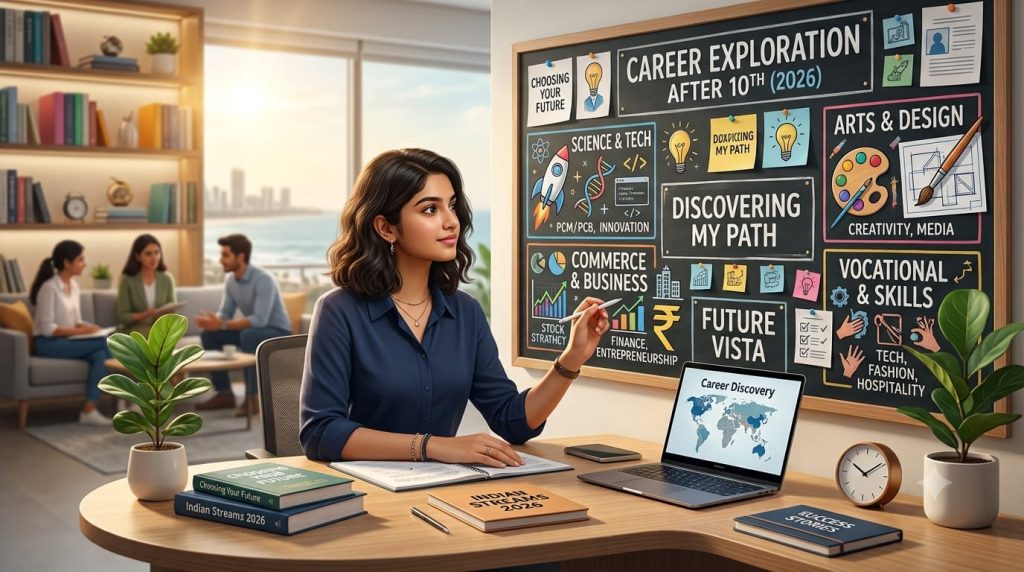
Confused after board exams? Read this 100% real, expert-backed guide on the best career options after class 10th to pick the right stream, diploma, or future-proof skill and get confident entrance in class 11th.
Introduction : The Moment Of Truth After Class 10th
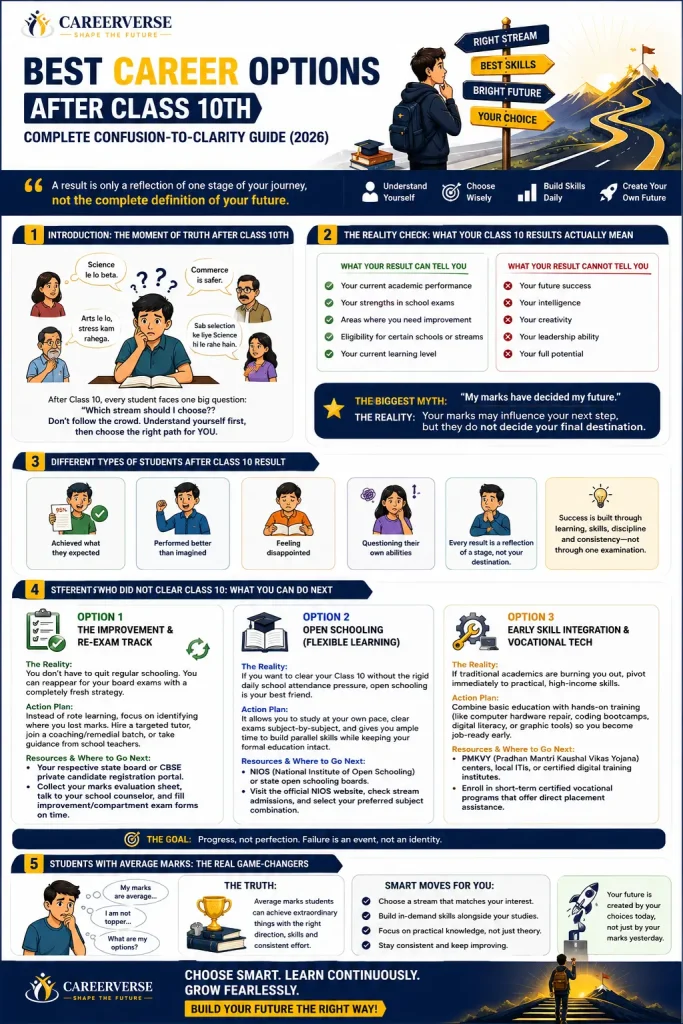
“Congratulations! Your Class 10 result is out. Now tell us…which stream are you choosing?”
This is one question that almost every student hears after completing their Class 10 board examination. For some students, this moment brings excitement. They celebrate their marks, share their results with family, and start planning their next academic journey. For others, it brings confusion. Suddenly, everyone has advice. Parents have expectations. Relatives start comparing. Friends begin discussing their choices. Teachers suggest different options. And somewhere between all these opinions, students often forget to ask the most important question: “What is actually right for me?”
At CareerVerse, we don’t believe choosing a stream is about following the crowd. We believe it’s about understanding yourself before choosing your career path.
The Reality Check: What Your Class 10 Results Actually Mean
Some students score more than expected. Some barely pass. Some become school toppers. Some fail and feel like everything is over. But here’s the reality: Every student is fighting a different battle.
A student who scored 95% may still be worried because they expected 98%. Another student who scored 60% may be celebrating because they worked incredibly hard to pass. A student who failed may feel embarrassed, while another may already be preparing to come back stronger. The same marks can mean completely different things to different students. That is why your result should never be compared with someone else’s journey.
What Your Result Can Tell You ?
| Your Result Can Tell You | Your Result Cannot Tell You |
| Your current academic performance | Your future success |
| Your strengths in school exams | Your intelligence |
| Areas where you need improvement | Your creativity |
| Eligibility for certain schools or streams | Your leadership ability |
| Your current learning level | Your full potential |
The Biggest Myth : “My marks have decided my future.”
But the reality is ….
Your marks may influence your next step, but they do not decide your final destination. Thousands of successful entrepreneurs, civil servants, scientists, creators, athletes, teachers, designers, and business leaders have followed different academic journeys. Success is built through learning, skills, discipline, and consistency—not through one examination.
Different Types Of Students After Class 10 Result
Every year, millions of students appear for Class 10 board examinations. When the results are announced, every student experiences a different situation:
- Some students achieve exactly what they expected.
- Some students perform better than they imagined.
- Some students feel disappointed.
- Some students start questioning their own abilities.
A result is only a reflection of one stage of your journey, not the complete definition of your future.
But one thing every student should understand : A result is only a reflection of one stage of your journey, not the complete definition of your future. Let’s understand different situations usually experience after class 10 results and what they should do next.

1. Students Who Did Not Clear Class 10
The first thought that comes into many students’ minds after an unexpected result is: “My future is over.” But this is not true.
Failing an examination is disappointing, but it is not the end of your academic journey. A single result cannot decide your intelligence, capability, or future success. The important question is not “Why did I fail?” The important question is: “What can I improve from this experience?”
Students who do not clear Class 10 have multiple options:
| Option & Route | What It Is & How It Works (The Solution) | Exact Resources & Where to Go Next |
| Option 1 : The Improvement & Re-Exam Track | • The Reality: You don’t have to quit regular schooling. You can reappear for your board exams with a completely fresh strategy. | • Resource: Your respective state board or CBSE private candidate registration portal. |
| • Action Plan: Instead of rote learning (ratta), focus on identifying where you lost marks. Hire a targeted private tutor, join a coaching/remedial batch, or take active guidance from school teachers. | • Action: Collect your marks evaluation sheet, talk to your school counselor, and fill out improvement/compartment exam forms on time. | |
| Option 2: Open Schooling (Flexible Learning) | • The Reality: If you want to clear your Class 10 without the rigid daily school attendance pressure, open schooling is your best friend. | • Resource: NIOS (National Institute of Open Schooling) or state open schooling boards. |
| • Action Plan: It allows you to study at your own pace, clear exams subject-by-subject, and gives you ample time to build parallel skills while keeping your formal education intact. | • Action: Visit the official NIOS website, check stream admissions, and select your preferred subject combination. | |
| Option 3: Early Skill Integration & Vocational Tech | • The Reality: If traditional academics are burning you out, pivot immediately to practical, high-income technical skills. | • Resource: PMKVY (Pradhan Mantri Kaushal Vikas Yojana) centers, local ITIs, or certified digital training institutes. |
| • Action Plan: Combine basic education with hands-on training (like computer hardware repair, coding bootcamps, digital literacy, or graphic tools) so you become job-ready early. | • Action: Enroll in short-term certified vocational programs that offer direct placement assistance. |
The goal should always be progress. Remember : Failure is an event, not an identity
2. Students With Average Marks: The Real Game-Changers
A large number of students fall into this category—scoring around 50% to 70%. The moment results are out, the comparison game starts. Relatives ask, “Kitne aaye?”, friends compare their 90s with your 60s, and sometimes even you start feeling like an average student who won’t achieve much.
Let’s clear this myth right now: School exams only test your ability to memorize and regurgitate information on paper in 3 hours. They do not test your street smarts, your problem-solving skills, or your hustle.
If you scored average marks, here is your reality check and action plan:
- Stop the Comparison Trap: The student who scored 95% by memorizing textbooks might struggle in the real world if they lack practical skills. On the other hand, average scorers often turn out to be the best entrepreneurs, managers, and problem-solvers because they learn how to navigate life outside the classroom.
- Find What Actually Interests You: Since you aren’t boxed into the intense pressure of being a “topper,” use this freedom wisely. Look closely at the subjects you actually didn’t mind studying. Did you enjoy reading stories in English? Did you find economics interesting? Or do you prefer practical, hands-on tasks over books?
- Focus on Skills, Not Just Marks Anymore: From Class 10 onwards, marks are just an eligibility ticket. Your true growth will come from what extra skills you build—whether it’s communication, basic coding, design, public speaking, or financial literacy.
Remember: An average scorecard does not mean an average future. Some of the most successful people in the world were average students who found their real passion later.
3. Students With Good Marks and Toppers:
But, Beware of the “Stream Trap”
Scoring above 90% is an amazing achievement—it shows your hard work, discipline, and sincere study habits. But high marks often bring a very unique kind of trap: The Pressure of Expectations.
- The “Science Only” Pressure: The moment a student scores well, society, relatives, and sometimes even parents assume: “Ab toh yeh Science (PCM/PCB) hi lega/legi.” Nobody asks what the student actually wants to do.
- Marks vs. Career: Remember, high marks are just an entry ticket. They open doors to good colleges, but they don’t decide your career passion. Choosing a stream just because you got the percentage for it—even if you hate Physics or Math—is a recipe for burnout.
- The Smart Move: Use your scores as your power, not your prison. If you genuinely love science, go for it. But if your heart lies in business, economics, law, design, or public policy, don’t be afraid to choose Commerce or Arts just because your marks allow you to take Science.
Remember: Your marks are your asset, but the final choice of your career should always be yours.
The Pressure After Class 10 — Parents, Society & Self-Expectations
Once results are out, the actual storm begins around the dining table. Phone calls start ringing, relatives ask “Kitne aaye?”, and the race to pick a stream begins.
This pressure doesn’t come from nowhere. Parents invest their hard-earned money, time, and resources into your education, expecting an outcome. When things don’t go as planned, fear kicks in—the fear of “Log kya kahenge?” (What will society say?).
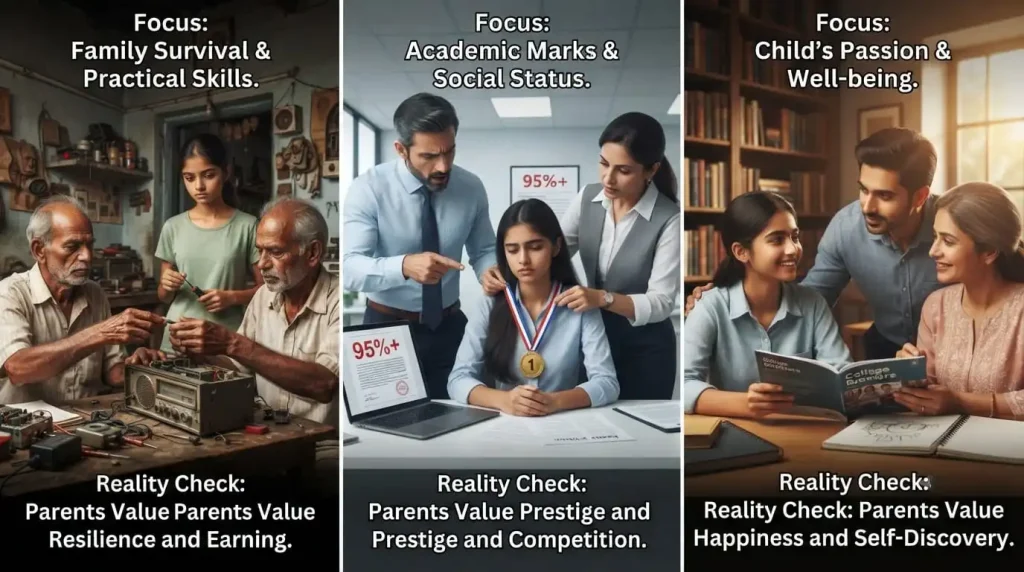
Instead of looking at parents negatively, we need to understand where this pressure comes from by looking at three distinct parenting mindsets:
1. Parents focused on family survival
- The Reality: These parents aren’t worried about report cards or school marks. For them, earning a living and basic financial stability matter more. They often involve the child in family work or early jobs to support the house.
- The Impact: While money problems are real, stopping a child’s studies too early without seeing their true talent can stop them from growing later in life.
2. Parents focused on marks and status
- The Reality: For these parents, anything below 95% feels like a big loss. Their mindset is fixed: “You must take Science or Maths.” Their pressure usually comes from worrying about what neighbors or relatives will say if their child is not a topper.
- The Impact: This causes heavy mental stress. Choosing a stream just to make others happy often leads to sadness and regret later.
3. Parents who understand their child
- The Reality: These parents know their child well. Whether the student gets 50%, 80%, or 90%, they value the hard work and support them. They completely ignore neighborhood gossip and social pressure.
- The Impact: This is the best support a student can get. When kids feel backed by their family instead of being judged, half their stress vanishes.
The Real Solution Is : Good Parenting Which Changes Everything
At the end of the day, a supportive family is your biggest shield. If your parents understand your strengths, guide you properly, and ignore toxic social pressure, no outside talk can break your confidence.
Good parenting doesn’t demand perfection; it builds a strong future.
How to Choose the Right Stream After Class 10: The Ultimate Roadmap
After dealing with results and family expectations, the biggest turning point arrives: Choosing your stream.
Class 10 practically revolves around this one decision. But how do most students actually end up picking their stream? Sadly, many choices are driven by the wrong reasons:
- Fear & Panic: Taking a stream just out of fear of failing or underperforming.
- Pressure: Choosing what parents or teachers force upon you.
- Comparison: Selecting a subject because your friends or relatives took it (“Usne Science li hai toh mujhe bhi leni padegi”).
Running your career on fear or comparison always leads to regret. To make the right choice, you need a clear, practical roadmap based on Goals and Interests.
Step 1: The Goal-Based Choice
If you already know what you want to become in the future—whether it’s an IAS officer, a teacher, a Chartered Accountant (CA), a doctor, or an engineer—your stream selection becomes very simple.
- The Rule: Match your ultimate career goal with the right stream. If your vision is crystal clear, let your goal drive your choice.
Step 2: The Interest-Based Choice (When Goal is Not Clear)
What if you don’t have a fixed career goal yet? That is completely normal. In that case, don’t panic or copy others. Instead, follow your genuine interests.
If your goal isn’t clear and you are confused about your interest, you need to discover it using a simple 2-step process:
1. Analyze Your Academic Subjects
Look back at all the subjects you studied in Class 10: Science, Maths, History, Political Science, Economics, Geography, and Language papers.
- Ask yourself: Which of these subjects did I actually enjoy reading without feeling bored?
- If history or polity excited you, Arts/Humanities might be your calling. If numbers and logic thrilled you, Commerce or Mathematics is waiting for you.
2. Look Beyond Academics (Extracurricular Activities)
What if you don’t find your interest in core textbooks? Look at your daily activities outside the classroom.
- Think about your hobbies: Music, drawing, painting, creative arts, sports, dance, or yoga.
- Many successful career paths today are built on these exact skills. Your extracurricular activities can give you a massive clue about where your true talent lies. Basically, that also become your passion.
Stream selection is the foundation of your future career roadmap. Don’t choose a stream because of peer pressure or fear. Either choose it based on a clear Goal, or find your Interest through your subjects and hobbies. Take your time, analyze yourself honestly, and pick a path you will love living every single day.
Choosing your stream in Class 11 is a huge milestone, but the reality check doesn’t stop there. Once you pick Science, Commerce, or Arts, a whole new set of challenges begins in school.

Class 11 Streams : Complete Factual & Career Scope Breakdown
1. SCIENCE STREAM
- Why Choose Science: Science is chosen by students who have a strong grip on analytical thinking, complex mathematical logic, and scientific experiments. It is the mandatory gateway for technical, medical, and core research fields where theoretical depth and empirical problem-solving are tested daily.
- Stream Options in Class 11 (CBSE Board Guidelines):
- PCM (Physics, Chemistry, Mathematics): The core engineering and technical track.
- PCB (Physics, Chemistry, Biology): The primary healthcare and life sciences track.
- PCMB (Physics, Chemistry, Mathematics & Biology): The dual-track option for students who want to keep both engineering and medical entrance exams (JEE and NEET) open simultaneously.
- Optional Add-ons: Computer Science (Python, C++, SQL), Artificial Intelligence, Data Science, Biotechnology, or Engineering Graphics.
- Core Academic Subjects: Physics, Chemistry, Mathematics/Biology, English, and one Elective/Optional subject.
| Career Domain / Field | Post Name / Title | Detail (What You Will Do) | Job Roles |
| Engineering & Tech | Software Engineer / Developer, AI/ML Engineer, Cloud Architect, Robotics Engineer | Build mobile apps, write computer software, and work with coding and digital systems. | Software Developer, Web Developer, App Programmer |
| Medicine & Surgery | Medical Doctor / Surgeon, MBBS Doctor, Cardiologist, Neurologist, Orthopedic Surgeon | Treat patients, diagnose illnesses, perform surgeries, and prescribe medicines. | MBBS Doctor, Specialist Surgeon, General Physician, Clinical Research, Sports Medicine, Genomic Medicine |
| Defense & Aviation | Military Officer / Pilot, Commercial Pilot, Aeronautical Engineer, Technical Officer (NDA Entry) | Serve as an officer protecting the country, fly commercial airplanes, or design aircraft. | Army/Navy/Air Force Officer (NDA), Commercial Pilot, Aeronautical Engineer, Avionics, Spacecraft Design, Defense Electronics |
| Research & Science | Research Scientist | Invent new technologies, study space, or conduct deep scientific experiments in laboratories. | Space Scientist, Physicist, Chemical Researcher |
| Architecture & Design | Architect | Plan and design large buildings, modern houses, malls, and public infrastructure. | Building Architect, Town Planner, Interior Architect |
| Agriculture & Food Tech | Agricultural Expert | Modernize farming methods, improve crop production, and ensure food safety standards. | Agronomist, Food Quality Manager, Crop Scientist |
| Paramedical & Therapy | Physiotherapist / Lab Expert | Assist doctors, help patients recover from injuries through therapy, and run medical tests. | Physiotherapist, Medical Laboratory Technician, Radiologist |
| Environment & Forestry | Environmental Scientist | Study climate change, protect forests, monitor wildlife, and work on reducing pollution. | Environmental Consultant, Forest Officer, Wildlife Biologist |
| Forensic Science | Forensic Expert | Help police and law enforcement by collecting evidence from crime scenes to solve cases. | Crime Scene Investigator, Forensic Analyst, Cyber Forensics Expert |
2. COMMERCE STREAM
- Why Choose Commerce: Commerce is chosen by students who are interested in business, money management, trade, finance, and corporate laws. It is designed for those who want to understand how markets, banks, and companies run financially.
- Stream Options in Class 11:
- Commerce with Mathematics: For advanced finance, banking, data analysis, and actuarial science.
- Commerce without Mathematics: Focuses on business studies, accounting, and general management without advanced math.
- Optional Add-ons: Informatics Practices, Entrepreneurship, Economics, or Applied Mathematics.
- Core Academic Subjects: Accountancy, Business Studies, Economics, Mathematics/Applied Mathematics, and English.
Complete Career Fields in Commerce (Class 11 Level Overview)
| Career Field | Post Name / Title | Detail (What You Will Do) | Job Roles |
| Accounting & Auditing | Chartered Accountant / Auditor | Manage company accounts, check financial records, file taxes, and ensure legal tax compliance. | Chartered Accountant (CA), Cost Accountant (CMA), Financial Auditor |
| Finance & Investment | Investment Banker / Analyst | Handle company investments, study stock markets, manage wealth, and raise business funds. | Investment Banker, Financial Analyst, Portfolio Manager |
| Corporate Management | Company Secretary / Manager | Manage company legal operations, handle corporate governance, and run business departments. | Company Secretary (CS), HR Manager, Operations Manager |
| Banking & Insurance | Bank Manager / Risk Officer | Handle bank operations, provide loans, manage customer accounts, and assess financial risks. | Bank PO, Credit Manager, Insurance Risk Assessor |
| Marketing & Advertising | Brand Manager / Marketer | Plan strategies to sell products, run brand campaigns, and study consumer buying habits. | Digital Marketing Manager, Brand Strategist, Sales Head |
| Economics & Policy | Economic Analyst | Study market trends, inflation rates, government policies, and global economic data. | Data Economist, Market Researcher, Policy Advisor |
| Law & Corporate Legal | Corporate Lawyer | Handle business contracts, legal disputes, company mergers, and corporate legal issues. | Corporate Attorney, Legal Consultant, Tax Lawyer |
| Digital Business & E-Commerce | E-Commerce Manager | Run online businesses, manage digital stores, and handle online sales and supply chains. | E-Commerce Specialist, Digital Store Manager, Growth Strategist |
| Stock Market & Trading | Stockbroker / Trader | Buy and sell shares, bonds, and assets on behalf of clients or financial institutions. | Equity Trader, Stock Broker, Financial Planner |
3. ARTS / HUMANITIES STREAM
- Why Choose Arts: Arts is chosen by students who are interested in human society, history, law, public policy, global affairs, and human behavior. It is designed for those who want to build strong critical thinking, writing, and analytical skills for governance and social leadership.
- Stream Options in Class 11:
- Core Social Sciences: Flexible subject combinations including History, Political Science, Geography, and Economics.
- Modern Electives: Additional choices like Psychology, Sociology, Legal Studies, Mass Media, or Fine Arts.
- Core Academic Subjects: History, Political Science, Geography/Economics, Sociology/Psychology/Legal Studies, and English.
Complete Career Fields in Arts (Class 11 Level Overview)
| Career Field | Post Name / Title | Detail (What You Will Do) | Job Roles |
| Civil Services & Administration | IAS / IPS / IFS Officer | Manage government policies, handle public administration, maintain law and order, and represent the country globally. | IAS Officer, IPS Officer, Foreign Service Diplomat, Public Policy Analyst |
| Law & Judiciary | Advocate / Judge | Fight legal cases, interpret laws, manage court trials, and protect individual or corporate rights. | Corporate Lawyer, Civil Rights Attorney, High Court Advocate, Judge |
| Media & Journalism | Journalist / Editor | Report news, investigate public issues, direct media content, and manage public relations. | Investigative Journalist, Content Director, News Anchor, PR Specialist |
| Psychology & Counseling | Psychologist / Therapist | Study human mental behavior, provide emotional counseling, and help individuals overcome mental health challenges. | Clinical Psychologist, Counselor, Behavioral Therapist |
| Psychology & Counseling | Psychologist / Therapist | Study human mental behavior, provide emotional counseling, and help individuals overcome mental health challenges. | Clinical Psychologist, Counselor, Behavioral Therapist |
| International Relations & Diplomacy | Policy Analyst / Diplomat | Study global politics, handle foreign affairs, work with international embassies, and manage peace agreements. | Geopolitical Analyst, Embassy Officer, UN Project Coordinator |
| Social Work & Development | NGO Director / Social Worker | Work with non-profit organizations, run social welfare campaigns, and handle community development programs. | Social Worker, CSR Manager, Human Rights Activist |
| Education & Academia | Professor / Researcher | Teach academic subjects, write educational books, and conduct historical or social research. | University Professor, Historian, Think-Tank Researcher |
| Creative Arts & Design | Fine Artist / Writer | Create visual artworks, write books, design content, or work in film and theatrical production. | Author, Creative Director, Fine Artist, Screenwriter |
Life After Stream Selection: Dealing with Judgment & Building the Right Circle
Phase 1: The Reality Check (Judgment & Taunts)
“Tune Arts li hai? Matlab padhai mein weak hoga!”
“Science li hai? Chal ab dikha apne 95%.”
Once you enter Class 11, the judgment game shifts from your marksheet to your stream:
- The Arts / Humanities Bias: Facing cheap comments from peers or relatives who think non-science streams are for “backbenchers.”
- The Science Burden: Drowning in peer pressure and constant stress just to prove a point to society.
- The Demotivation Trap: Dealing with constant comparisons that make you second-guess your own choices.
Phase 2: Your Class 11 Survival & Growth Toolkit
To block out this negativity and build a solid foundation, follow these four rules:
- 1. Build a Mentor Bond (Connect with Teachers)
- Stay close to teachers who actually inspire you. Don’t just study for passing marks; clear your concepts, ask questions, and take their guidance when things get tough.
- 2. Master the Art of Research (Use AI & Google)
- We live in a smart digital era. Stop relying blindly on outdated textbooks. Use Google and AI to dig deeper into topics, understand real-world applications, and build your own independent thinking.
- 3. Filter Your Circle (Choose the Right Company)
- Sangat ka asar padta hai. Stay away from toxic groups that mock your choices or waste time. Surround yourself with people who talk about goals, learning, and mutual growth.
- 4. Chase Consistency, Not Perfection
- Class 11 syllabus is a massive jump from Class 10. Don’t panic on day one. Focus on small, steady daily progress instead of running a blind race with others.
Conclusion: Your Future, Your Rules
Choosing your path after Class 10 is not about satisfying society, winning a family status race, or copying your best friend. Whether you choose Science, Commerce, Arts, or take an alternative vocational route, remember one simple truth: A stream is just a vehicle, but the driver is YOU.
No stream is small, and no mark-sheet can ever measure your true potential, hard work, or future success. What matters most is how consistently you learn, how deeply you understand your subjects, and how smartly you build your skills outside the classroom.
Take a deep breath, trust your gut, block out the neighborhood noise, and make a choice you will be proud of tomorrow. Your journey has just begun—make it legendary!